
In today’s day and age, the idea of life without the internet is almost unfathomable. Even people who grew up without it wonder how they ever made it this far. According to the Pew Research Center, 90% of adult Americans use the internet, but how many of that number have any idea what the internet really is?
Most people, including myself until just recently, confuse the internet for the World Wide Web. The World Wide Web is this extended network of websites that we’re on right now. With its creation came the creation of hyperlinks and the URL.

The internet, on the other hand, is the actual hard drive that the World Wide Web is powered by. It’s the vast network of computers and databases connected by copper wires that run across continents and around the world. Yes, the internet is made up of actual wires running across miles and miles of land! If that’s not odd enough, the World Wide Web was invented over 20 years after the internet was created in 1969. So, what was the internet even used for up until that point?
After the space wars had been ignited, President Eisenhower responded to the Soviet satellite “Sputnik” being launched into space, by creating ARPA. The Advance Research Projects Agency (ARPA) was established within the U.S. department of defense in 1958, and was the world’s first operational network, before the internet. At this point computers already existed, but they could only do one task at a time and could not send information.
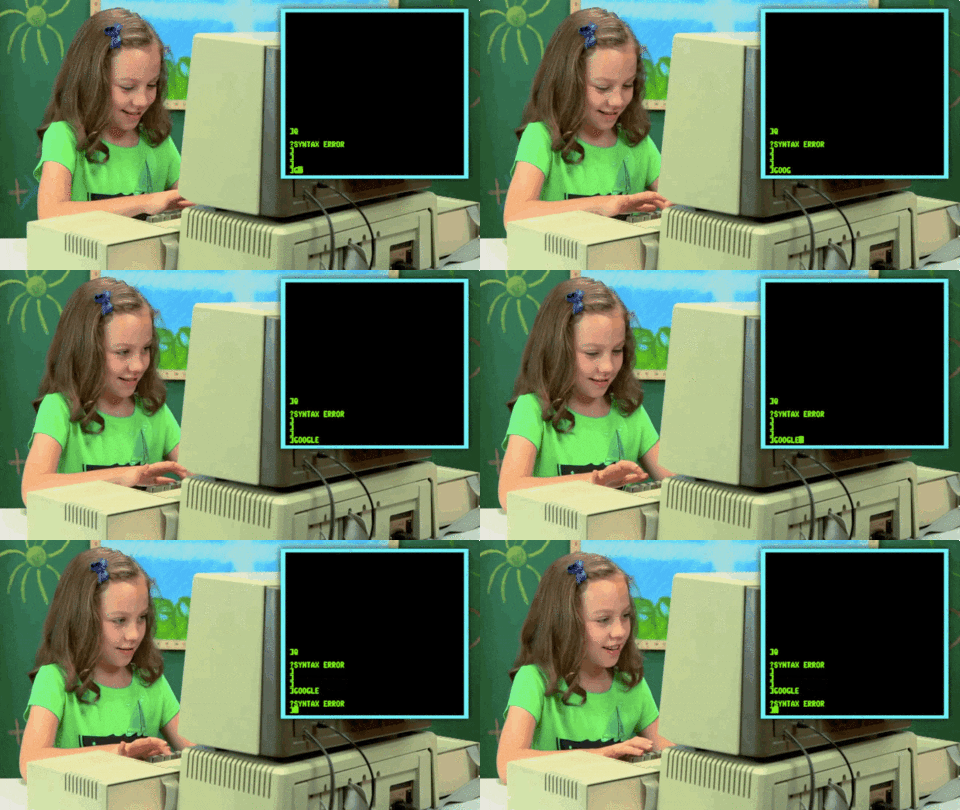
After the ARPA team was spread out across different U.S. Universities, they decided to create the first computer network, called ARPAnet, which connected just four computer systems at the time. In 1971, Ray Tomlinson created the email so that ARPAnet staff could send each other messages. By 1973, the ARPAnet had gone global and spanned across 51 universities and research centers.
The word ‘Internet’ didn’t pop up until a decade later in 1982. Once businesses got a hold of the new technology, they realized they could use it to offer their customers faster and better services, so they started putting lots of money into the development of the Internet.
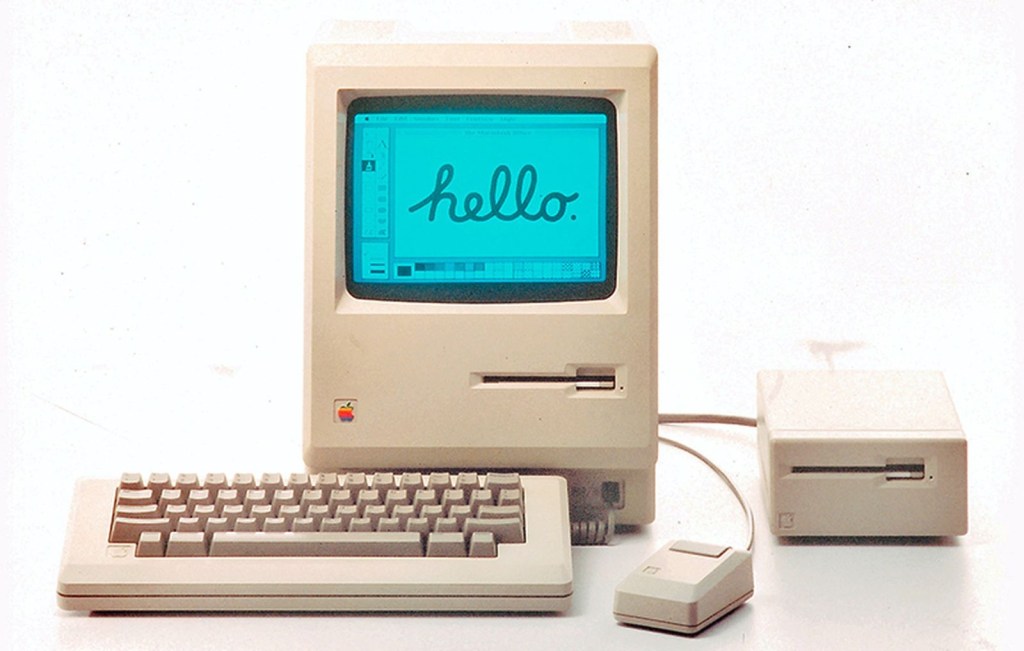
The competition that was created among hardware and software suppliers in trying to meet this new demand, caused prices to drop and become much more affordable to the average citizen. Around this time is when Microsoft came out with the MacIntosh computer; and when computers became (relatively) smaller and started being seen in everyday homes.
In 1989, Tim Berners-Lee created the World Wide Web, allowing all consumers to access the internet through the use of hypertexts that linked one site to another through hyperlinks. There were no set standards for the Web until 1994 when Berners-Lee developed the World Wide Web Consortium. After this, the Web grew by 2300% in 1994, and took off from there.

Back in 1967, Philco-Ford predicted the “1990s home” in a video that showed a woman online shopping, a man paying bills from the computer, parents watching their kids playing outside using a household monitor, and more technological advancements that came to life in the 2000s. He couldn’t have been more on the nose… psychic or genius?
Since the start of the century, the number of people using the internet has grown exponentially, now reaching the 90% that we see today in the U.S. This number probably doesn’t surprise anyone, but what about the 10% not using the internet? Most of us can’t imagine life without it, but for the 10%, most of them don’t have much of a choice.
The Pew Research Center suggests that a person’s likelihood of using the internet can be determined by age, location, education, income, and ethnicity. It was found that roughly 3 in 10 adults with less than a high school degree do not use the Internet. Senior citizens and citizens living in rural areas are also less likely to use the internet. While 92% of white people use the internet, that number drops to only 85% for Black people, and 86% for Latinos.
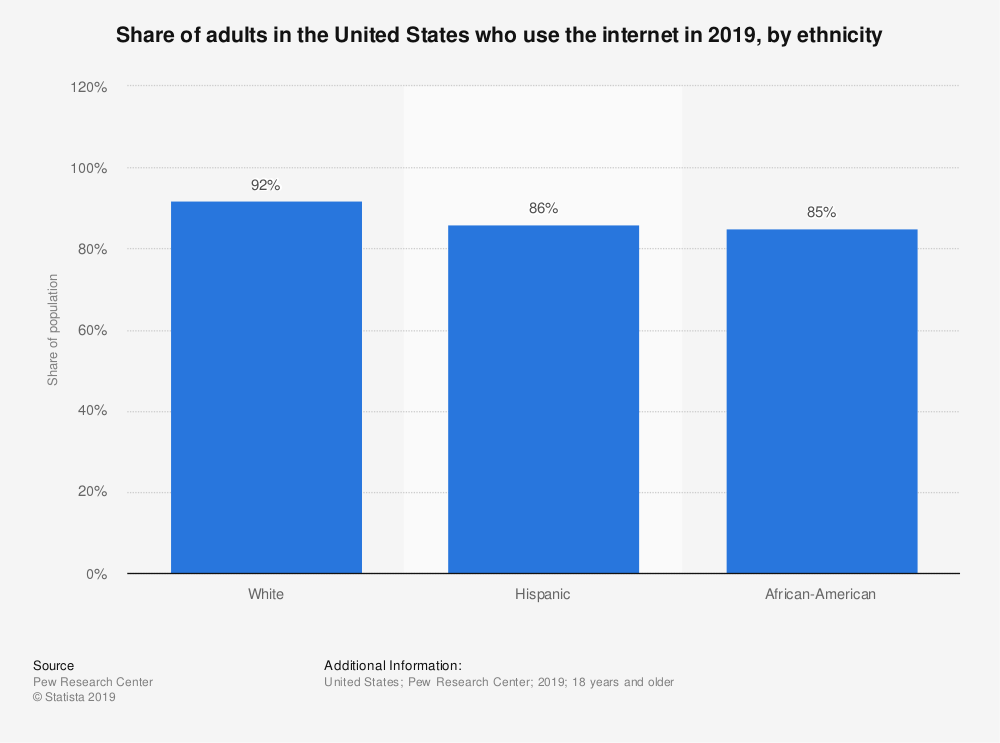
It can be assumed that if everyone had equal access to resources, the number of internet users in the U.S. would be at nearly 100%. Unfortunately, we aren’t there yet, but according to the projections, we’re getting closer and closer.
 Mezcla