Review and Critique of Black Mirror’s “Nosedive”
It’s pretty obvious that social media has become a huge part of our everyday 21st-century lifestyles, but have you ever wondered what would happen if we let it get the point where it dominates our entire social system? Well, the Netflix original series, “Black Mirror,” did it for us.
The short, film-styled episode, “Nosedive,” directed by Joe Wright, is set in alternate future reality where social media has turned into social reality. Citizens of this society give eachother ratings on a scale of 1-5 stars after every interaction and in response to every social media post. Through advanced eye implants, everyone can see each other’s ratings at all times and can access their public profiles instantly. The storyline follows main character Lacie Pound, played by Bryce Dallas Howard, as she struggles to increase her ratings, but instead ends up finding a sense of liberation that she never knew existed.
Plot
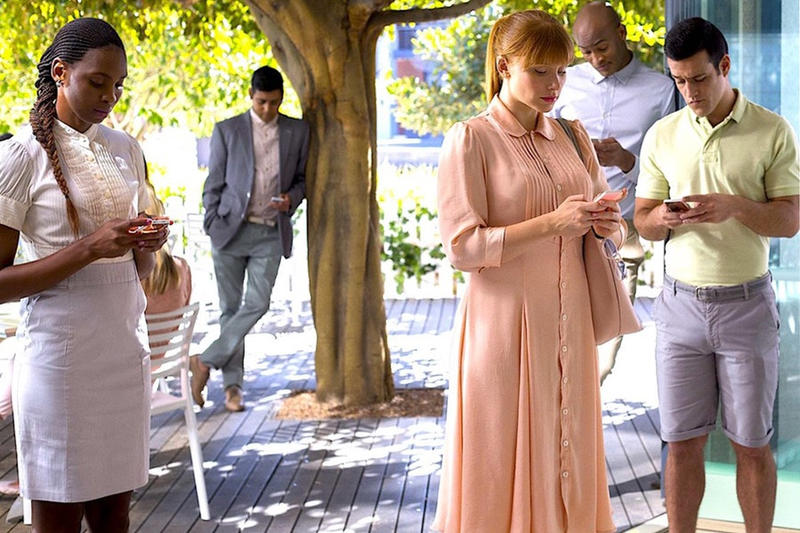
The film begins with a typical day in the life of Lacie Pound, as she runs, eats, and goes to work, all while scrolling through her social media feed. Through her routine, the audience is given a comprehensive understanding of the utilitarian society in which the film takes place. Lacie is shown practicing her laugh in the mirror, posting cute pictures of food she won’t eat, and having uncomfortable fake conversations. It quickly becomes evident that in this reality, every decision made is viewed and criticized by the public, defining people’s perceptions of themselves and others.
It doesn’t take long before it’s evident that ratings are actually used to represent socio-economic status. In fact, money isn’t mentioned once throughout the film. But, people with high-ratings clearly constitute the wealthy and famous, while people with low ratings are ostracized and excluded from opportunities.
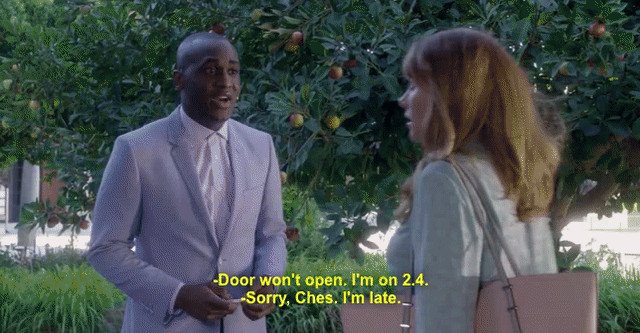
This fact is presented with the introduction of Lacie’s coworker, Ches [played by Kaddiff Kirwan]. As Lacie sits at her desk, she’s approached by Ches, whose rating has suddenly dropped to a 3.1. Ches offers her a smoothie, and when she accepts it, she’s given dirty looks from all around the office. After he walks away, another one of Lacie’s coworkers leans over and tells her that no one is talking to Ches anymore after he and his partner broke up. The office had decided collectively to take a side, and were actively trying to diminish Ches’ rating to a 2.5 so he would lose his job — the first glimpse into the ugliness that lies beneath this seemingly “perfect” society.
In the film, Lacie lives with her brother [played by James Norton] who doesn’t care much for the social expectations of society, so he stays inside playing video games with his friends most of the time, explaining his 3.1 rating. Lacie admits later on that she doesn’t bring people back to their apartment because she’s embarrassed of him, showing that she cares more about her public perception than her own family.
In an attempt to boost her rating so she could move away from her brother and into a new “4.5 and up” apartment complex, Lacey devises a plan to reconnect with a childhood friend, who just so happens to be a 4.9. In their reconnecting, Naomi [played by Alice Eve] invites Lacie to her wedding and asks her to be her maid-of-honor on the spot. We find out later, that this was also a manipulative ploy on Naomi’s end to gain a better social standing.
Giving the perfect speech at Naomi’s wedding, which would have over a hundred “4.7s and up” in attendance, would give Lacie the social boost that she needed to get the apartment of her dreams, so when her brother tried to warn her of Naomi’s intentions, she didn’t want to hear it. She wouldn’t even admit the truth to herself. The two of them broke out into a huge fight right before she left for the airport, and from then on, it was all downhill.

After their argument, Lacie’s brother gave her a low rating. Then, while storming out of her house, she bumped into a woman, resulting in another low rating. When she was finally in the airport, she was told by the worker that her flight was cancelled and that she couldn’t get on the next one because her rating was a 4.18 and it needed to be a 4.2. Maybe it was karma for her obsession with her public image and shallowness towards her brother… if only she was as nice behind closed doors as she was when she was in public.
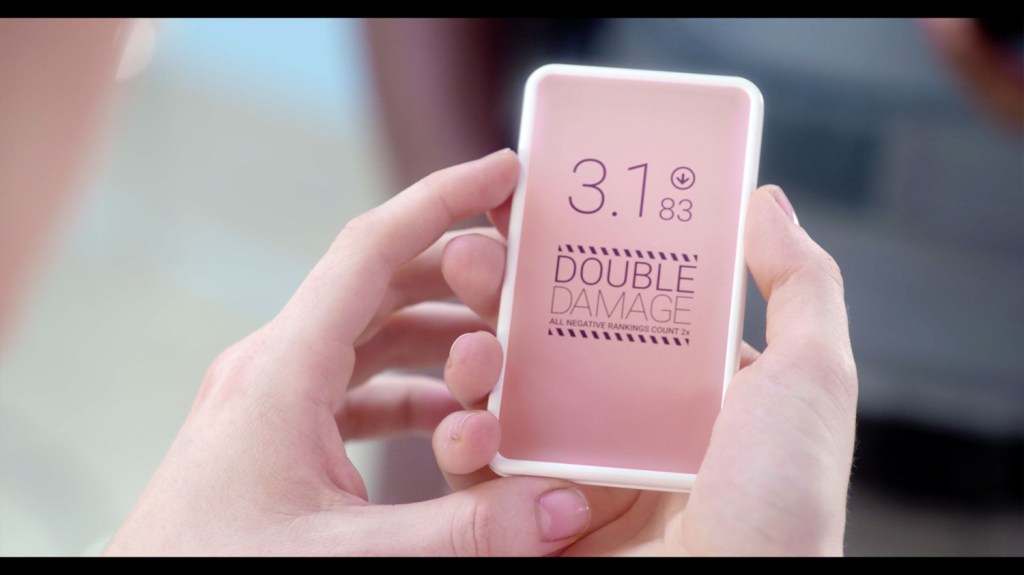
Of course, being emotional due to her perceived need to be at the wedding and earn those ratings, she was angered at the worker’s lack of willingness to accommodate her, and blew up, leading to multiple bad ratings from airport bystanders. When the worker finally called the security guard, he placed Lacie on a social penalty that knocked her down a rating for 24 hours, and when she begged him not to, he put her on double damage.
The attitude of the airport worker and security guard shined light on the fact that this is clearly an authoritarian government with little to no true freedoms, and that their rating system is a strict form of social control that’s so deeply embedded in their culture, most people don’t even realize.
Determined to get to Naomi’s wedding and boost her ratings, Lacie embarks on a 10-hour adventure riddled with one failure after another. Her now 2.8 rating made it virtually impossible to do anything. She couldn’t get on a bus, she couldn’t get a functioning rental car, and she couldn’t even hitch rides from strangers. As the challenges increased, Lacie’s ratings decreased even more.
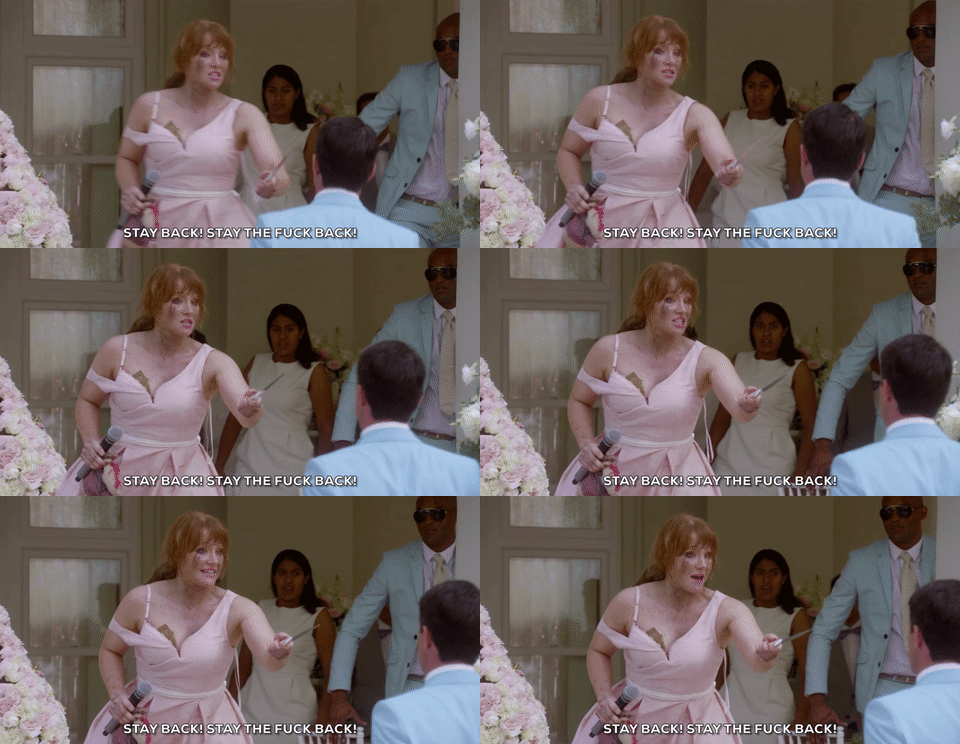
Lacie finally shows up to the wedding, against Naomi’s explicit instructions not to, having a 1.1 rating. Worse than that, she was drunk, covered in mud, and looked like she’d gone mad. Lacie gave a nonsensical speech that took a violent turn and resulted in her being arrested.
After being detained, Lacie’s eye implants are removed — and she sees the particles floating in the air for the first time in probably most of her life. It’s in this moment that she begins to appreciate the little things in life that she’s lost sight of.
The film closes out with Lacie in a jail cell across from a guy who’s in a similar position to her. The two of them start insulting each other, since for the first time, they’re able to speak their minds freely. Screaming at each other from their cells, Lacie and her jail mate finally get to release everything they’ve been holding in for most of life.
Critique
The film got off to a slow start, but I think that was exactly how it was supposed to be. The peaceful, quiet opening scene of Lacie starting her day, along with the abundance of pastel colors that dominated every scene visually, set a mood that perfectly reflected the utopian society in which the film was based. This provided a great contrast for the ending which was loud, crude, and fast-paced. The colors were flipped in the last scene when Lacie sits in a grey, cement jail cell, and removes her pastel pink dress — the last piece of that “perfect”, phony society that she traded for her emotional liberation. The visuals definitely evoked moods that matched the story line as it progressed.
I also applaud the creators for their casting choices. Each actor really embodied their character in appearance and execution. Even if they never gave any backstories, I think viewers still would’ve had an equal level of understanding, which is saying a lot. Bryce Dallas Howard did an amazing job portraying the complex thoughts and emotions of Lacie. The role required her to reflect not only Lacie’s outward character, but her deeper emotional self simultaneously, which couldn’t have been easy. So, 5-stars for Howard on this one.
One thing I will point out — and I hate to be that person — is that all of the black characters were either outcast (like Ches, and the man in jail), or held some part in Lacie’s demise (like the woman who gave her a bad rating, and the airport worker who called security on her). Not to mention, they were all, of course, supporting or background roles… but that’s all I’ll say on that.

The fact that this was a Netflix original meant that the writers could throw in as much profane language as they pleased, which I found as a huge plus in creating a stark contrast between people’s phony public presentations, and their raw, emotional inner characters. One slight downfall is the easily predicted ending, but the dramatization, comedic undertones, and great acting excused that in my opinion.
Final Rating
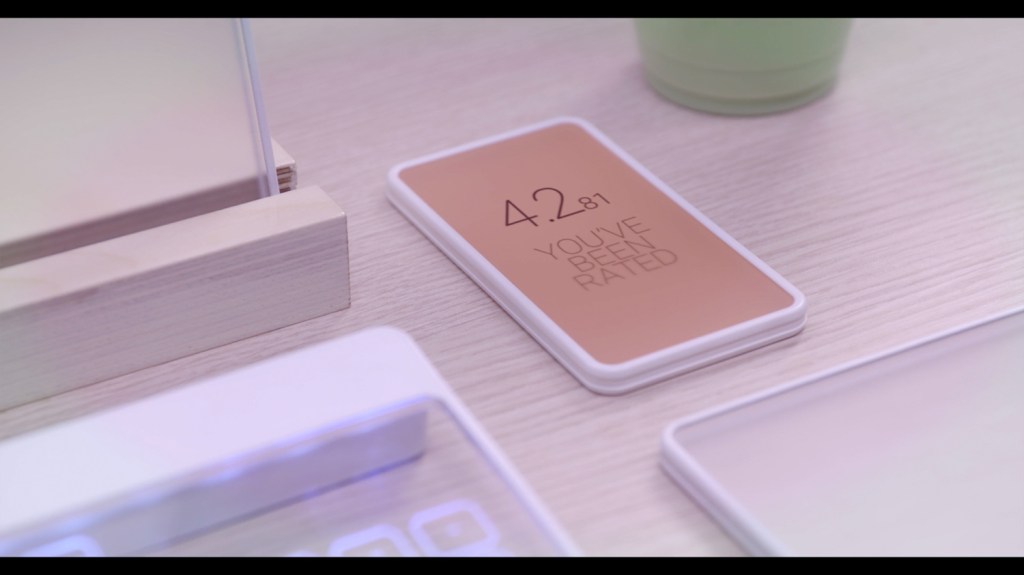
I would give “Nosedive” a 4.2 overall. If you take a look at the set up of today’s Chinese society and the Peeple app, you’ll realize that the writers weren’t quite as out-of-the box in developing this “future” reality, as some may have thought. Still, in my opinion, it was a great concept with a visually pleasing artistic presentation. It was equal parts light-hearted and eerily deep, with comedic undertones that make it pleasurable for anyone watching. All-in-all, “Nosedive” is a thought-provoking, entertaining, well-executed film and I would highly recommend it to anyone who can handle a few f-bombs here and there.
 Mezcla