How Are You Judged as You Walk Down the Street?
By Kendal Parker
Feb. 3, 2020
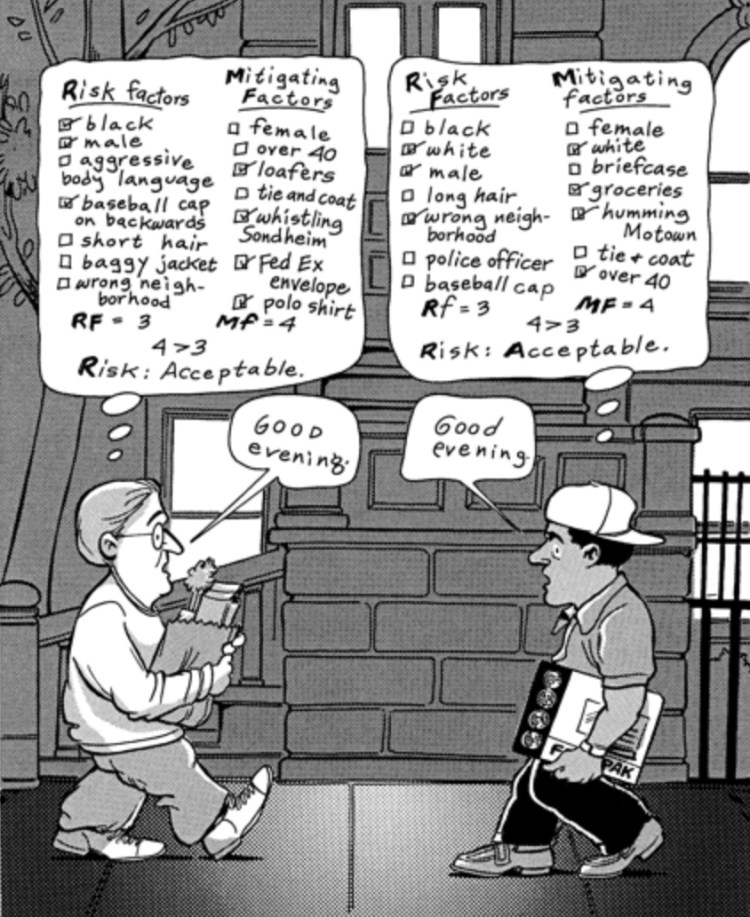
Most people would like to believe that they are fair and just in their judgement of others, but communication experts may beg to differ. Bias is everywhere — the news, television, textbooks, policy — but how often do we look at our biases in day-to-day interactions? Garry Trudeau’s cartoon, entitled “Street Calculus,” depicts the mental process people go through when judging whether another person is a risk to them or not.
The cartoon shows two men walking past each other on the street. One is a young, well-dressed black man, holding a fedex package and wearing a backwards baseball cap. The other is an older white man, wearing glasses, and holding groceries. They say “good evening” to each other externally, but internally they’re calculating the risk factors that the other person holds to determine whether they are safe to interact with or not.
The two men in the cartoon are walking down an inner city street, which to me, being a New Yorker, looks like Brooklyn. In that context, the cartoon becomes very accurate and relatable to me in particular. With the growing gentrification in inner city areas, like Brooklyn, there’s an increasing number of white people moving into what were once mostly black neighborhoods.
To the African-Americans who’ve lived in these neighborhoods for years, and even generations, these white people are outsiders and don’t “belong”, therefore increasing their risk factor. Conversely, a white person who’s just moved into one of these neighborhoods sees it as their new home, and a black man walking down the street at night in a baseball cap or hoodie, is deemed to have a high risk factor. Can you see both sides?
Trudeau uses this cartoon to express that everytime we have an interaction with a new person, we use visual factors to determine if they are safe to engage with or not. Looking at the cartoon, you’ll notice that the two people share some of the same measurements of risk.
For example, in the cartoon, being black equates to risk, and location has an effect on risk levels. In both character’s heads, being female, being over 40, and looking professional are all mitigating factors — meaning they decrease the perceived risk .
Though there are some shared standards, each person’s unique list is dependent on their culture and past experience. The experiences that a person has in regards to their race, will certainly play into how they will judge people in future interactions.
I find “Street Calculus” to be a suitable and witty title for this cartoon. Trudeau is describing this process of weighing a person’s risk factors against their mitigating factors (information that reduces a person’s risk factor), and using the remaining information to deem that person a risk or not. It’s an extremely quick and subconscious calculation done in the first three seconds of seeing someone.
I find the message to be extremely relevant and I think it’s something more of us should learn about in order to curb our own unfair judgements and biases. Before making a quick judgement of someone else, first run this risk assessment on yourself. You may be surprised how someone would judge you as you walked down the street.
 Mezcla